Why ending hunger requires more than producing enough food—and how fighting poverty can help families achieve lasting food security.
The world produces enormous quantities of food, yet millions of people still struggle to eat enough. For some families, the challenge is finding food at all. For others, food is available in nearby markets, but the cost of a nutritious diet remains beyond their reach.
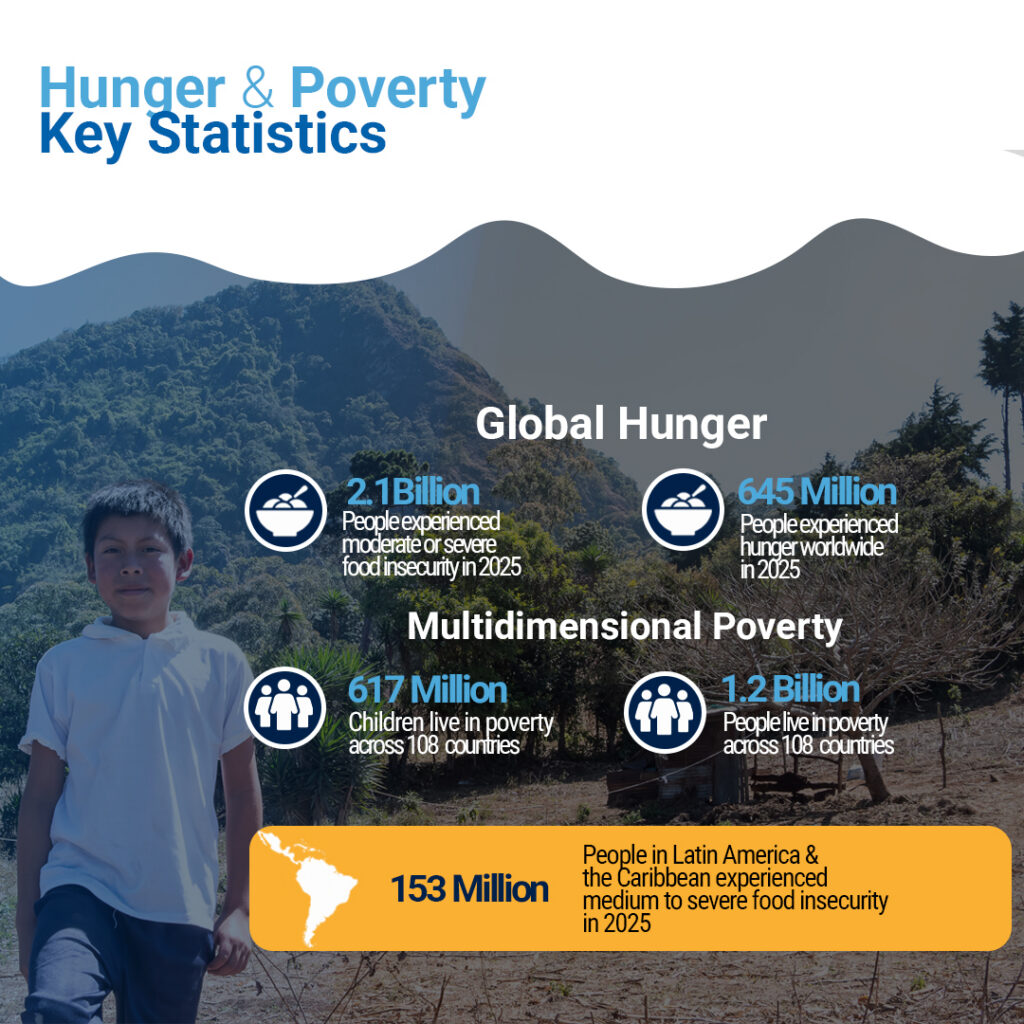
According to the United Nations’ State of Food Security and Nutrition in the World 2026, approximately 645 million people experienced hunger in 2025, while 2.1 billion people faced moderate or severe food insecurity.
Perhaps even more revealing, an estimated 2.69 billion people—nearly one-third of the world’s population—could not afford a healthy diet.
These figures reveal an important distinction: hunger is not always the result of insufficient food production. It can also occur when people lack the resources needed to access nutritious food.
This raises a fundamental question: Is hunger primarily a food problem or a poverty problem?
The answer is both, but the distinction matters.
Food shortages can cause hunger, particularly during droughts, disasters, conflicts, and disruptions to agricultural production. However, hunger can also persist in places where food is readily available. Families may simply lack the income, resources, or opportunities needed to obtain it.
Research shows that hunger cannot be understood through food production alone. It is closely connected to poverty, access to essential services, and the stability of household livelihoods.
Understanding these connections is essential to developing solutions that do more than address hunger today. It helps explain what families need to achieve lasting food security.
Understanding Food Insecurity: Hunger Is More Than an Empty Plate
Hunger and food insecurity are closely related, but they are not identical.
Hunger generally refers to the physical discomfort and consequences of not consuming enough food. Food insecurity is a broader condition in which people lack reliable access to sufficient, safe, and nutritious food for a healthy and active life.
A family does not have to experience prolonged starvation to be food insecure.
Food insecurity may begin with uncertainty about whether there will be enough food for the coming week. Parents might purchase cheaper, less nutritious ingredients, reduce portion sizes, or skip meals so their children can eat.
Over time, these compromises can affect health, development, and overall well-being.
Four Dimensions of Food Security
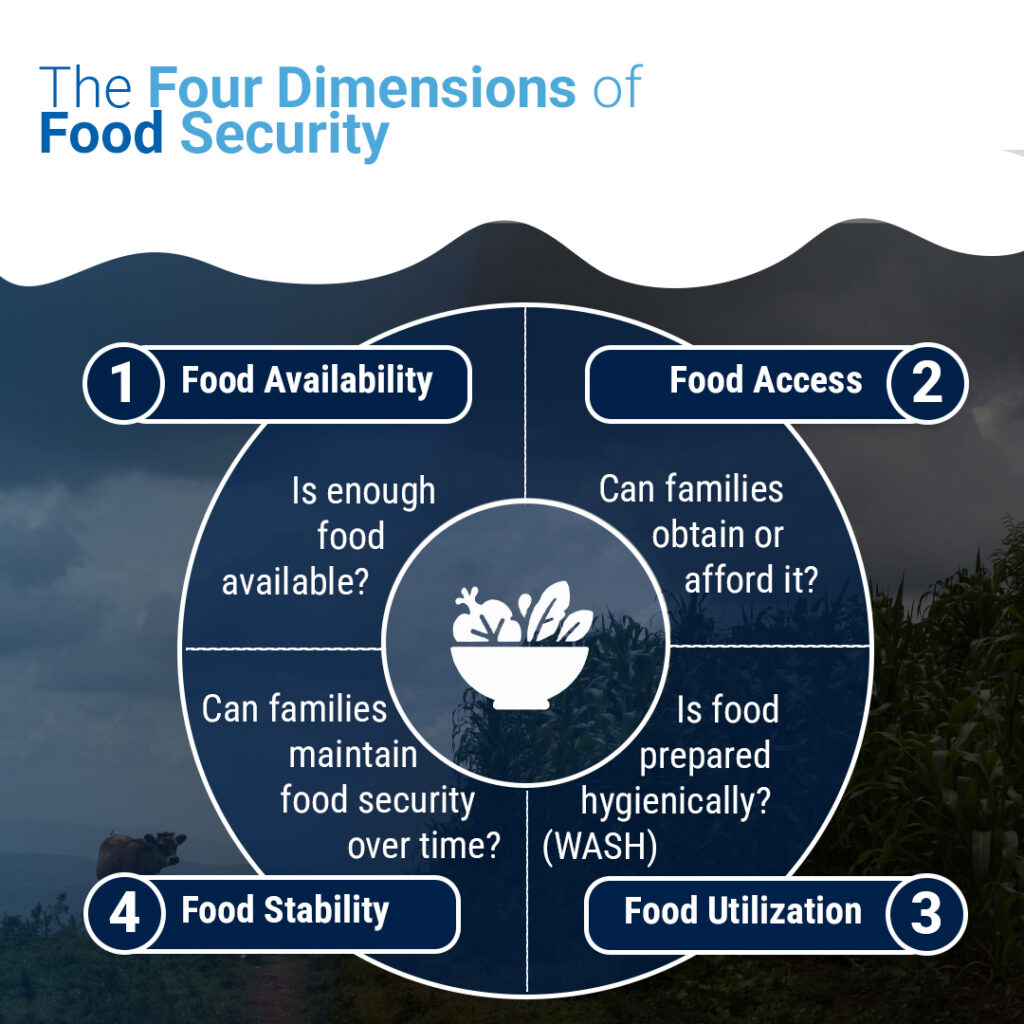
The Food and Agriculture Organization of the United Nations (FAO) identifies four fundamental dimensions of food security:
1. Food Availability
Is enough food physically available through agricultural production, imports, markets, or food assistance?
2. Food Access
Do individuals and households have the financial and physical means to obtain that food?
3. Food Utilization
Can people consume nutritious diets and benefit from them through appropriate food preparation, healthcare, clean water, and sanitation?
4. Food Stability
Can households maintain adequate food access over time, including during economic downturns, seasonal shortages, natural disasters, and other disruptions?
These dimensions explain why increasing agricultural production, while important, does not automatically eliminate hunger.
A market can be filled with fresh produce, grains, and other foods, yet families may still struggle to afford them. A farming household may produce crops but lack sufficient income to purchase other foods necessary for a balanced diet.
Likewise, a child may consume enough calories but still experience malnutrition because their diet lacks essential vitamins, minerals, and other nutrients.
Food security depends not only on the presence of food, but also on people’s ability to access and benefit from it consistently.
The distinction is reflected in global statistics. While approximately 645 million people experienced hunger in 2025, the number experiencing moderate or severe food insecurity was more than three times as large.
This broader measure captures households whose access to food is uncertain or compromised, even when they do not experience persistent hunger.
The FAO’s Food Insecurity Experience Scale reinforces this understanding by measuring people’s experiences of food-related uncertainty, compromised dietary quality, and reduced food consumption.
Understanding food insecurity through these dimensions changes how we think about hunger—and the solutions needed to address it.
The Link Between Hunger and Poverty
One of the most influential contributions to understanding hunger came from economist and Nobel laureate Amartya Sen.
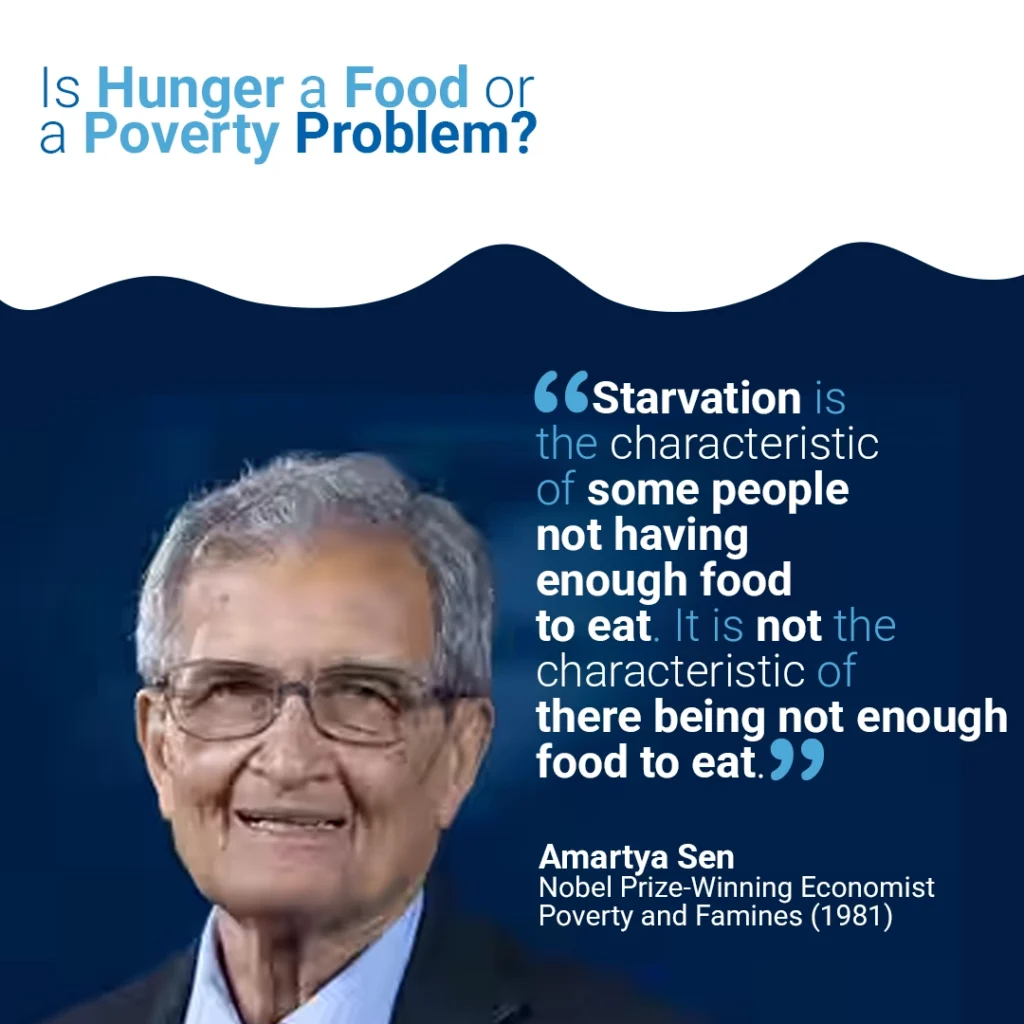
In his landmark 1981 book Poverty and Famines: An Essay on Entitlement and Deprivation, Sen wrote:
“Starvation is the characteristic of some people not having enough food to eat. It is not the characteristic of there being not enough food to eat.”
— Amartya Sen, Poverty and Famines (1981), p. 1
This observation challenged the assumption that famine and starvation are always caused by an overall shortage of food.
Sen demonstrated that people can experience severe hunger even when food remains available within a country or region.
The underlying problem may be a loss of what Sen called entitlements: the ability to obtain food through employment, agricultural production, trade, ownership, or other legitimate means.
For example, when food prices rise faster than wages, a household may lose the ability to purchase enough food even if market supplies remain unchanged.
Similarly, when farmers lose their harvests or workers lose their jobs, their access to food may deteriorate because they no longer have the resources needed to obtain it.
Sen’s research fundamentally changed how economists and humanitarian organizations understand hunger.
The question is not simply whether enough food exists, but whether people have the means to obtain it.
How Poverty Limits Access to Food
For households living in poverty, food purchases compete with other essential expenses, including housing, transportation, education, healthcare, and utilities.
When income is insufficient, families face difficult decisions.
A parent may delay medical treatment to purchase groceries. A household may reduce spending on nutritious foods to cover school expenses. Families may rely on inexpensive, energy-dense foods because fruits, vegetables, and other nutrient-rich products are unaffordable.
These decisions are not simply matters of personal preference. They reflect the economic constraints under which families live.
The scale of this challenge is significant.
In 2025, approximately 2.69 billion people worldwide could not afford a healthy diet, according to the United Nations’ 2026 food security report.
This figure is particularly important because it distinguishes having enough calories from being able to obtain the variety of foods necessary for good nutrition.
A household may avoid immediate hunger while remaining vulnerable to nutritional deficiencies and poor health.
Food Affordability in Latin America and the Caribbean
The relationship between hunger and purchasing power is particularly relevant to Latin America and the Caribbean.
According to the 2026 UN food security report, approximately 22.9% of the region’s population experienced moderate or severe food insecurity in 2025.
The report also estimated that the minimum cost of a healthy diet in the region reached $4.91 per person per day in purchasing-power-parity (PPP) dollars, the highest regional average globally.
PPP dollars account for differences in purchasing power between countries; they should not be interpreted as actual US-dollar grocery prices in every community.
For families living on limited or irregular incomes, the cost of a nutritious diet can represent a substantial financial burden.
In rural communities, this challenge may be compounded by limited market access, seasonal employment, agricultural disruptions, and inadequate infrastructure.
These conditions illustrate why hunger cannot be separated from the broader economic circumstances in which families live.
How Hunger Reinforces Poverty
The relationship also works in the opposite direction.
Poverty can contribute to hunger, while hunger and malnutrition can make it harder for people to escape poverty.
Inadequate nutrition can affect children’s physical growth, learning, and development. Among adults, poor nutrition can reduce health and productivity, potentially limiting opportunities to earn a stable income.
According to the 2026 UN food security report, approximately 150 million children under five worldwide were affected by stunting, a condition associated with chronic or recurrent undernutrition.
Stunting is more than a measure of height. At the population level, it reflects nutritional and health disadvantages that can have lasting consequences for child development.
These effects can accumulate across generations.
A child who experiences prolonged nutritional deprivation may face disadvantages in education and health. Those disadvantages can influence future employment opportunities and economic security.
This creates a reinforcing cycle:
Poverty limits access to nutritious food. Poor nutrition can undermine health, learning, and productivity. These disadvantages can make it more difficult for families to improve their economic circumstances.
Breaking that cycle requires addressing hunger and poverty together.
Multidimensional Poverty: Why Hunger Is Connected to Other Forms of Deprivation
Poverty is often described in financial terms: how much money a person earns or whether a household lives below a defined poverty line.
Income is an important measure of economic well-being, but it does not capture every aspect of deprivation.
Two households with similar incomes may experience very different living conditions.
One family may have access to clean drinking water, nearby healthcare, reliable electricity, and a functioning school. Another may need to travel long distances for medical care, rely on unsafe water, and live in housing that offers little protection from extreme weather.
Their incomes may be similar, but their opportunities to remain healthy, secure, and food secure are not.
This is the foundation of multidimensional poverty.
Researchers Sabina Alkire and James Foster developed an influential approach to measuring poverty through overlapping forms of deprivation rather than income alone.
Their methodology contributed to the development of the Global Multidimensional Poverty Index (MPI), published by the United Nations Development Programme (UNDP) and the Oxford Poverty and Human Development Initiative (OPHI).
According to the 2026 Global Multidimensional Poverty Index, approximately 1.2 billion people across the 108 countries assessed experienced multidimensional poverty.
The findings demonstrate why poverty cannot be adequately understood through income measurements alone.
The Global MPI examines three broad dimensions:
Health
Nutrition and child mortality are important indicators of deprivation.
Poor nutrition can be both a consequence of poverty and a factor that makes poverty more difficult to escape.
Education
School attendance and years of schooling influence people’s ability to acquire knowledge, develop skills, and access future economic opportunities.
Educational barriers can limit a household’s long-term earning potential and economic resilience.
Living Standards
Access to clean water, sanitation, electricity, adequate housing, clean cooking fuel, and basic household assets helps determine the conditions in which families live.
These resources also influence food security.
For example, limited access to clean water and sanitation can increase the risk of illness, while unreliable electricity may make food storage more difficult.
Inadequate transportation and infrastructure can isolate rural communities from markets, healthcare facilities, and employment opportunities.
Why These Deprivations Matter for Hunger
Consider a family living in a rural community where agricultural employment is seasonal.
Even if the family earns enough during harvest season to purchase food, several overlapping challenges may threaten its long-term food security.
Without reliable water infrastructure, growing crops may become increasingly difficult during dry periods. Without nearby healthcare, preventable illnesses may impose additional costs. Without adequate roads, farmers may struggle to transport their products to markets.
Limited educational opportunities can further restrict the household’s ability to diversify its income.
Each of these challenges affects food security, directly or indirectly.
Together, they can create conditions in which hunger remains persistent despite the family’s efforts to improve its circumstances.
Multidimensional poverty helps explain why hunger is rarely an isolated problem. It is often one visible consequence of several interconnected disadvantages.
Why Income Alone Isn’t Enough to End Hunger
If poverty is a major driver of hunger, wouldn’t increasing household income solve the problem?
Higher incomes can make a substantial difference. Families with greater purchasing power are generally better positioned to afford food, manage unexpected expenses, and make choices about their diets.
However, income alone does not guarantee adequate nutrition or long-term food security.
Several additional conditions matter.
1. Nutritious Food Must Be Available and Affordable
A family may earn more money but still struggle to maintain a healthy diet if nutritious foods are scarce or unusually expensive.
In some communities, access to fresh produce, protein-rich foods, and other essential ingredients is limited by transportation costs, weak market infrastructure, or disruptions to local agriculture.
Food affordability therefore depends on more than household income. It also depends on the cost, availability, and distribution of nutritious food.
The estimated 2.69 billion people unable to afford a healthy diet illustrate the scale of this economic challenge.
Strengthening local agriculture, improving market access, and supporting more resilient food systems can help address these barriers.
2. Clean Water and Sanitation Support Nutrition
Food consumption is only one part of nutritional well-being.
Unsafe drinking water, inadequate sanitation, and repeated infections can undermine health and nutrition, particularly among young children.
The UNICEF Conceptual Framework on Maternal and Child Nutrition emphasizes that adequate diets must be accompanied by appropriate care and access to essential services.
This helps explain why efforts to reduce malnutrition often involve more than providing food.
Access to clean water, sanitation, hygiene education, and healthcare can complement nutritional interventions and help create healthier living conditions.
3. Education and Knowledge Influence Nutrition
Education can help families understand nutritional needs, food preparation, hygiene, and appropriate feeding practices.
It can also improve economic opportunities, helping households build more secure livelihoods over time.
However, nutrition education alone cannot overcome financial barriers.
Knowing what constitutes a healthy diet does not mean a family can afford the necessary ingredients.
Effective approaches must therefore consider both knowledge and access.
4. Economic Stability Matters as Much as Income Growth
A temporary increase in income may improve food access without providing lasting security.
Families dependent on seasonal employment, small-scale agriculture, or informal work may experience substantial fluctuations in earnings.
A failed harvest, unexpected medical expense, or sudden increase in food prices can quickly reverse financial progress.
For this reason, long-term food security depends partly on the stability and resilience of household livelihoods.
Access to diverse income sources, agricultural resources, functioning markets, and appropriate support during emergencies can help families better withstand future disruptions.
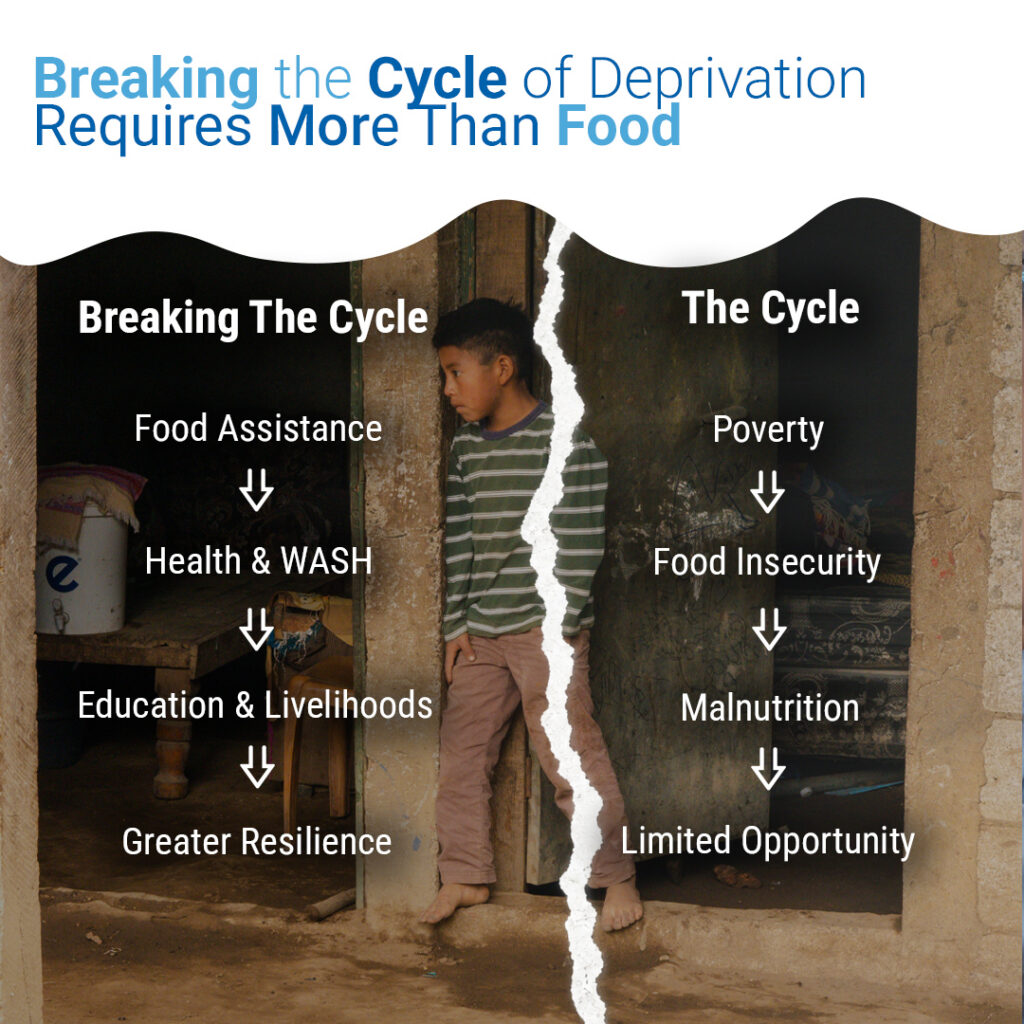
Fighting Hunger Requires Both Immediate Relief and Long-Term Solutions
The research points toward an important conclusion: hunger cannot be addressed through a single intervention.
When families lack food today, immediate assistance can be essential. Food distributions, emergency nutrition programs, and other humanitarian responses help meet urgent needs, particularly during disasters and economic crises.
But lasting food security also requires addressing the circumstances that make families vulnerable to hunger.
This means looking beyond food supplies to the broader conditions affecting household well-being.
Sustainable agriculture can help farming families improve production and strengthen their livelihoods. Access to clean water and sanitation can support healthier communities. Education and economic opportunities can improve families’ ability to earn a living and make choices about their future.
Improved infrastructure and market access can also help connect producers with buyers, reduce barriers to trade, and expand access to essential goods.
These approaches are complementary rather than competing.
Emergency food assistance can help families through immediate hardship, while long-term investments in livelihoods and community infrastructure can address some of the underlying causes of food insecurity.
Addressing Hunger and Poverty Together
At Food For The Poor, the connection between hunger and poverty is central to our humanitarian mission.
Providing food to people facing immediate hardship is an important part of responding to human need. At the same time, sustainable community development recognizes that families need opportunities, resources, and essential services to build more secure futures.
Initiatives involving agriculture, clean water, housing, education, and economic empowerment address different dimensions of poverty that can influence long-term food security.
The goal is not simply to help families get through the next meal. It is to support conditions in which they have a better opportunity to meet their needs and become more resilient to future challenges.
So, Is Hunger a Food Problem or a Poverty Problem?
Hunger is both a food problem and a poverty problem.
Food must be produced, distributed, and made available. But availability alone does not guarantee that everyone can eat.
People also need the resources to obtain food, access to nutritious diets, essential services that support health, and livelihoods stable enough to withstand economic and environmental shocks.
Amartya Sen’s research demonstrated that hunger cannot be explained solely by shortages in food supply. Multidimensional poverty research further shows why income alone cannot capture all the disadvantages that affect a family’s well-being.
The global statistics reinforce these findings.
When 645 million people experience hunger, 2.1 billion face food insecurity, and 2.69 billion cannot afford a healthy diet, the challenge extends beyond the quantity of food produced.
It is also about economic opportunity, affordability, nutrition, and the conditions necessary for families to build stable lives.
Ending hunger requires ensuring that food is available today while addressing the poverty and structural barriers that prevent families from accessing nutritious food tomorrow.
That is why lasting progress depends on connecting immediate humanitarian assistance with sustainable solutions that strengthen communities, expand economic opportunities, and help families build a future beyond poverty.
References and Further Reading
- Sen, A. (1981). Ingredients of Famine Analysis: Availability and Entitlements. The Quarterly Journal of Economics, 96(3), 433–464.
- Sen, A. (1981). Poverty and Famines: An Essay on Entitlement and Deprivation. Oxford University Press.
- Alkire, S., & Foster, J. (2011). Counting and Multidimensional Poverty Measurement. Journal of Public Economics, 95(7–8), 476–487.
- Carlo Cafiero⁎ , Sara Viviani, Mark Nord Food (2017) security measurement in a global context: The food insecurity experience scale
- FAO, IFAD, UNICEF, WFP & WHO (2026). The State of Food Security and Nutrition in the World 2026.
- UNDP & Oxford Poverty and Human Development Initiative (2026). Global Multidimensional Poverty Index.
- UNICEF (2020). Conceptual Framework on the Determinants of Maternal and Child Nutrition.
- FAO. Cost and Affordability of Healthy Diets: Methods.